PVC dry bags use polyvinyl chloride film, the budget workhorse that is tough, puncture-resistant and easy to RF weld. Specify phthalate-free PVC and avoid extreme cold, where PVC stiffens and can crack.
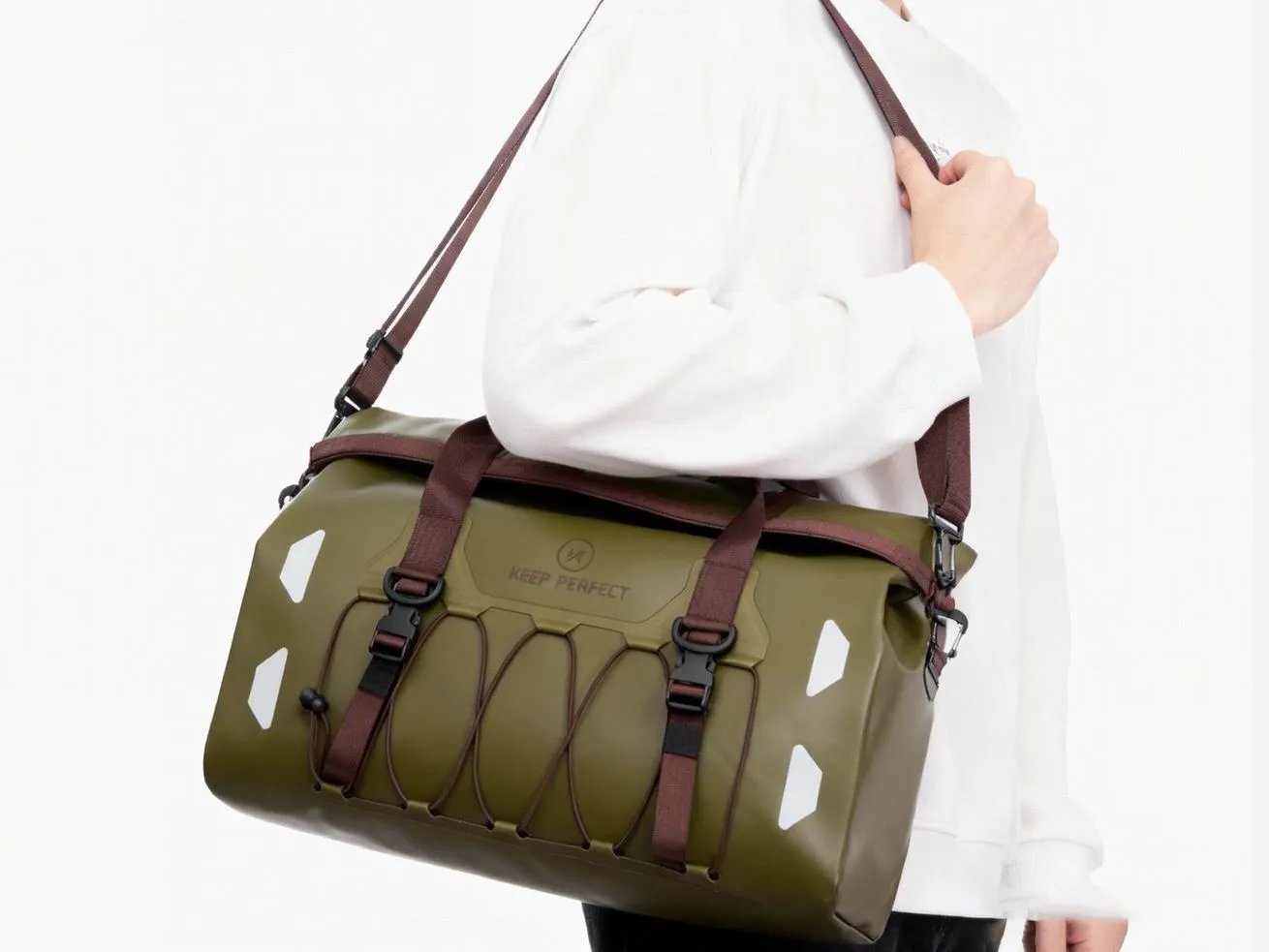
People searching for "pvc dry bags" usually want a direct, practical answer - and this page delivers one. This guide explains the PVC dry bag materials and construction methods that determine waterproofing, weight, durability and cost, so you can choose the right film and seam for your use case.
Why PVC is everywhere
PVC is inexpensive, abrasion-resistant and welds quickly with RF equipment, so it powers most budget and heavy-duty dry bags. The low cost makes it ideal for volume and promotional use.
Durability trade-offs
PVC resists punctures and scuffs well, but it stiffens in freezing temperatures and can harden over years of sun exposure. UV stabilizers help, though TPU still outperforms it in cold.
The compliance angle
Standard flexible PVC can contain phthalates, which several markets restrict. Always request phthalate-free PVC and matching test reports for the EU and similar regions.
Durability and puncture resistance
PVC is the most puncture-resistant of the common PVC dry bag films, which is why it dominates rafting and heavy-duty bags. TPU is softer and can be punctured more easily at equal thickness but flexes better over time.
For rough use - rocky rivers, sharp gear, hauling - choose a thicker PVC or TPU. For packability and light use, a coated nylon or thin TPU saves weight without sacrificing basic waterproofing.
TPU, PVC and coated nylon compared
TPU (thermoplastic polyurethane) is a flexible, weldable film that stays soft in cold weather and resists UV better than PVC. It is the premium choice for lightweight, high-performance dry bags.
PVC (polyvinyl chloride) is tougher and cheaper but heavier, and it stiffens below freezing. Coated nylon uses woven nylon with a waterproof coating or laminate, giving the lightest and most packable fabric.
Coatings vs laminates
A coated PVC dry bag has a waterproof layer applied to one side of the fabric; a laminate bonds a film to the fabric. Laminates are usually more durable and easier to weld, but both can be fully waterproof.
Ask which construction a supplier uses, because it affects weight, weldability and how the bag ages. Laminated TPU is the common premium construction.
Why seams matter more than fabric
A PVC dry bag leaks at the seam or closure far more often than through the film. That is why factories spend so much effort on welding quality and closure hardware, and why stitched bags must be seam-taped.
When evaluating a supplier, ask about the welding method and the seam test. A smooth RF weld with documented seam-strength testing is a strong signal that the bag will hold water out.
Denier and film thickness
A PVC dry bag spec lists film thickness in mil or mm and, for coated fabrics, denier for the base weave. Higher denier means a heavier, tougher base fabric, while thicker film adds puncture resistance and weight.
Match the numbers to the abuse: a thin, light film suits packable travel bags, while a thicker film or higher denier suits river and expedition use.
Cold weather behavior
PVC stiffens in cold, which makes a PVC dry bag harder to roll and close in winter conditions. TPU stays flexible down to lower temperatures, which is why it is preferred for skiing, alpine and cold-water use.
If you paddle or travel in cold climates, choose TPU or a TPU-coated nylon. If the bag will live in a warm climate or a boat locker, PVC's stiffness is less of a problem.
| Property | Value |
|---|---|
| Abrasion | Excellent |
| Cold | Stiffens |
| Cost | Low |
| Material | Waterproofing | Weight | Durability | Cold / UV | Cost |
|---|---|---|---|---|---|
| TPU | Excellent, weldable | Light | Good | Best UV, soft in cold | Higher |
| PVC | Excellent, weldable | Heavier | Very high | Stiffens in cold, moderate UV | Lowest |
| Coated nylon | Good (depends on coating) | Lightest | Good | Moderate | Medium |
| Method | How it works | Best for |
|---|---|---|
| RF / high-frequency | Fuses film with electromagnetic energy | PVC and TPU seams |
| Heat sealing | Heated bar melts film together | Thinner films, simple seams |
| Seam taping | Waterproof tape over stitched seams | Coated nylon fabrics |
| Priority | Best material |
|---|---|
| Lightest weight | Coated nylon |
| Lowest cost | PVC |
| Cold weather | TPU |
| Puncture resistance | Thick PVC |
| UV exposure | TPU |
| Thickness | Typical use |
|---|---|
| 0.3-0.5mm | Light travel bags |
| 0.5-0.7mm | Everyday dry bags |
| 0.7mm+ | Expedition and river bags |
Why PVC still dominates budget dry bags
PVC-laminated polyester remains the default for entry-level dry bags because it is cheap, abrasion-tough and forgiving. A 0.5 mm PVC laminate weighs about 500 to 650 g/m², welds at 320 to 360 degrees Celsius, and tolerates punctures that would end a TPU film bag. It is the fabric you see on $15 beach roll-tops and on commercial rafting outfit bags.
The downsides are weight (a 20 L PVC bag runs 450 to 600 grams empty), cold stiffening (PVC gets rigid below about 5 degrees Celsius), and environmental pressure around phthalates and plasticizer migration. For tropical beach and boat use, those downsides rarely matter.
Thickness and what it means
PVC dry bags come in 0.35 mm, 0.5 mm and 0.7 mm gauges. The 0.35 mm is a 5 to 10 L day bag for light use; 0.5 mm is the workhorse for 20 to 30 L paddling bags; 0.7 mm is the expedition gauge for rafting and commercial rental. Each 0.15 mm step adds roughly 150 g/m² of weight and about 15 percent to material cost, but roughly doubles abrasion life.
A common buying mistake is spec-ing 0.7 mm for a 5 L phone pouch - you carry the weight penalty for no real benefit. Match gauge to capacity and abuse: small pouches 0.35 mm, general roll-tops 0.5 mm, commercial and rafting bags 0.7 mm. our affiliated manufacturer welds all three gauges on the same die-cut patterns so buyers can ladder SKUs without re-tooling.
Welding parameters that matter
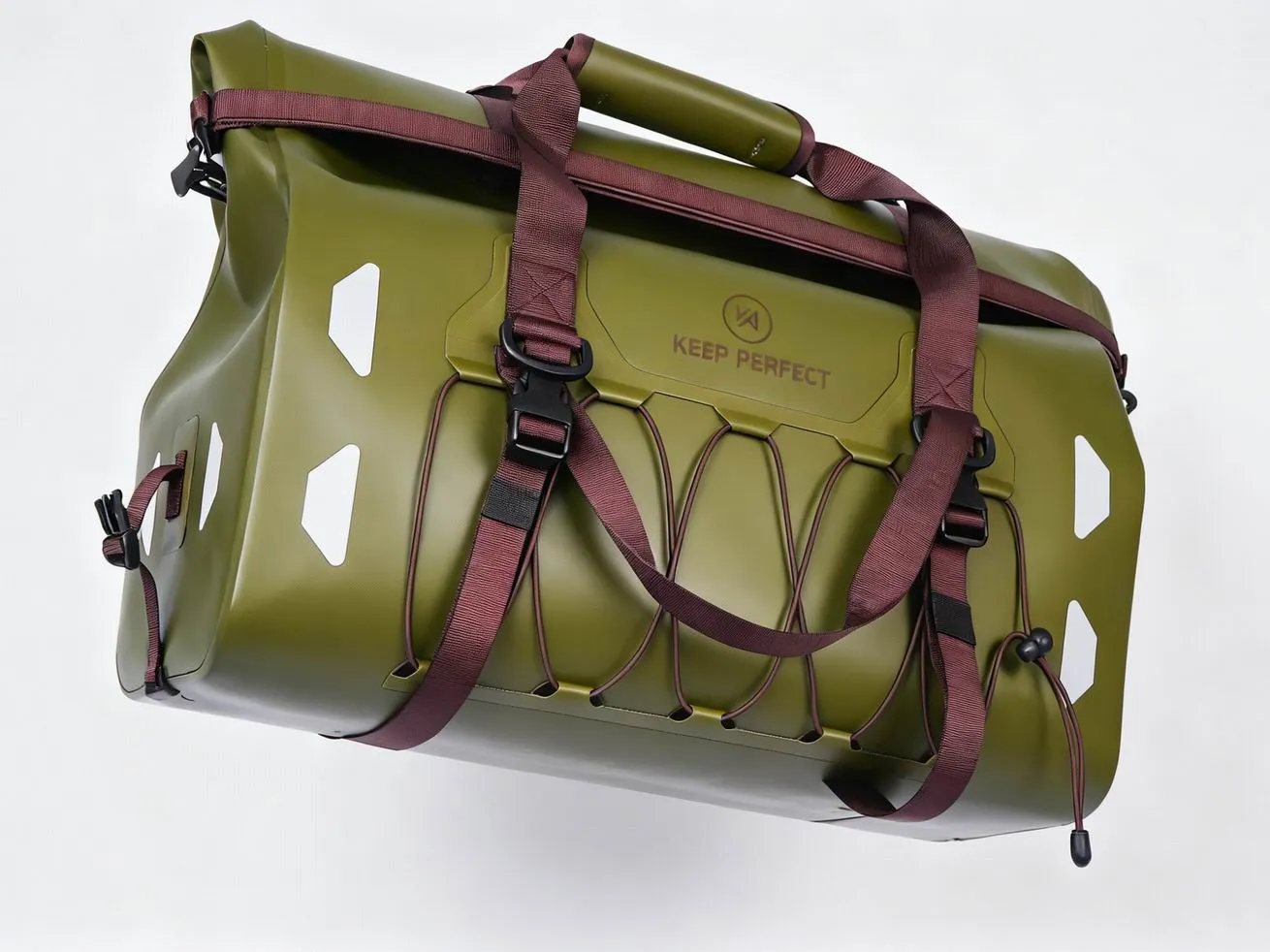
PVC is rf-welded (high-frequency welded) at 27.12 MHz, with electrode pressure around 0.3 to 0.5 MPa and a dwell of 1.5 to 3 seconds depending on gauge. A correctly welded PVC seam hits 120 to 180 N/25mm peel - stronger than the film itself, which is why PVC bags fail at the D-ring pull-out before the seam splits.
Under-welded PVC seams look fine but delaminate after a season; over-welded seams foam and become brittle. The factory should pull-test 3 samples per lot and log the number. Ask for that log before you pay the balance.
PVC end-of-life and recycling
PVC is harder to recycle than TPU because of the plasticizers, and it releases HCl if burned. For eco-conscious brands, this is a real liability; for marine and industrial use, it is irrelevant. If you market the bag as eco, switch to TPU or rPET; if you market it as tough and cheap, PVC is still the workhorse.
PVC film gauges and when each is right
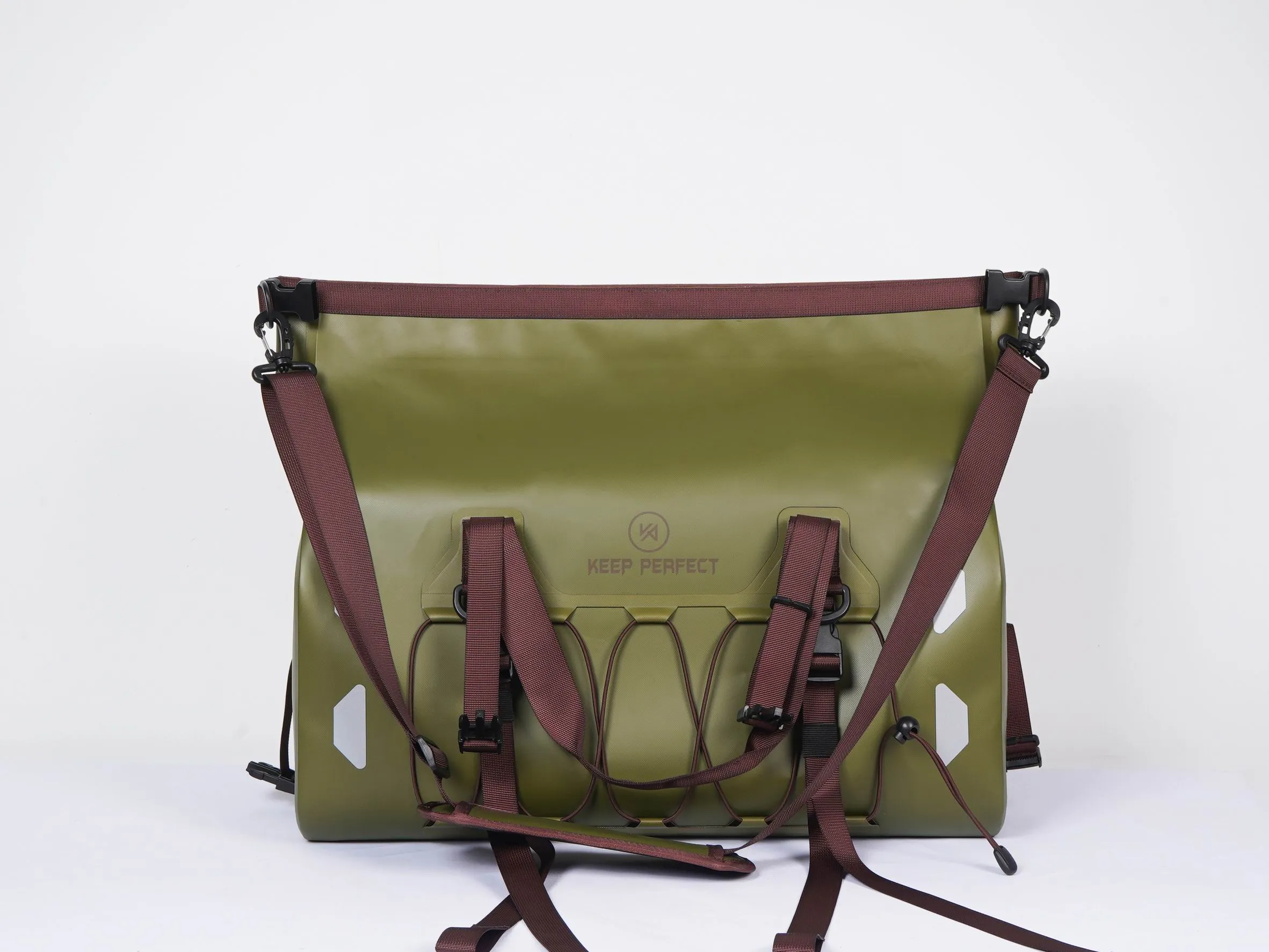
0.35 mm PVC is a 5 to 10 L day bag: light, cheap, for occasional beach and pool use. It punctures on reef edges and rocks. 0.5 mm PVC is the workhorse: 20 to 30 L roll-tops for kayaking, boating and SUP. It survives abuse and costs $3.5 to $5.5 FOB. 0.7 mm PVC is expedition grade: 40 to 60 L for rafting, commercial rental and overlanding. It is heavy but indestructible.
Do not over-spec. A 0.7 mm PVC phone pouch is absurdly heavy. A 0.35 mm PVC rafting bag will not survive one season. Match gauge to capacity and abuse, and keep the same die-cut pattern across gauges so you can offer a light and tough version of the same SKU. The film gauge is the spec that buyers feel but never see on the tag.
PVC cost structure
A 0.5 mm PVC roll-top at 1,000 pieces runs $3.5 to $5.5 FOB: about $1.80 to $2.50 film, $0.40 buckle and D-rings, $0.50 webbing and strap, $1.00 to $1.50 labor and overhead, $0.30 packaging. At 5,000 pieces, the per-unit drops 10 to 15 percent. PVC is the cheapest waterproof film because the polymer is abundant and welding is fast.
The environmental cost of PVC is real but not borne by the factory. If your brand markets eco, switch to TPU or rPET. If you market tough and cheap, PVC is still the workhorse. Know which buyer you are.
PVC dry bag FOB price ladder
0.35 mm PVC roll-top: $2.50 to $4 at 1,000 pieces. 0.5 mm: $3.50 to $5.5. 0.7 mm: $5 to $7.5. At 5,000 pieces, each tier drops 10 to 15 percent. The film is 40 percent of the cost, labor 30 percent, hardware 15 percent, overhead and packaging 15 percent.
PVC is the cheapest waterproof film. Budget the phthalate-free premium (10 percent) if selling to EU or California. Standard PVC is fine for tropical beach and industrial use.
PVC bag end-of-life options
PVC is hard to recycle curbside, but specialist polymer recyclers accept it. For a brand running a take-back program, collect worn PVC bags and ship them to a recycler. Otherwise, a worn PVC bag goes in general waste - do not burn it, as it releases HCl. Dispose of responsibly and avoid claiming recyclability unless you have a take-back program.
PVC film thickness and weld spec
PVC dry bags use 0.5 to 1.0 mm film, calendared and then high-frequency welded along the seams. A 0.5 mm film weighs about 500 gsm and suits a 10 L day bag; a 0.8 to 1.0 mm film weighs 800 to 1,000 gsm and suits a 40 to 60 L expedition or rafting bag that takes abrasion on river rocks. The weld is made by a 5 kW RF welder at 27.12 MHz, with a 10 to 12 mm weld bead that peels at 30 to 45 N per 25 mm. Cheap bags use a 6 to 8 mm weld that peels at under 20 N and fails on a loaded strap.
PVC is heavier than TPU but cheaper and more puncture-resistant, which is why it dominates whitewater and military-adjacent use. At MOQ 1,000, a 20 L PVC roll-top bag runs USD 4.5 to 7 FOB. For export to the EU, request phthalate-free DEHP-free PVC compound, because standard PVC contains plasticisers restricted under REACH. Ask for the material test report (EN 71-3 or REACH SVHC) with each shipment.
People also ask
What is the difference between TPU and PVC dry bags?
TPU is lighter, softer and more UV-stable; PVC is heavier, more puncture-resistant and cheaper. TPU suits premium packable bags; PVC suits rugged, high-volume bags.
Does dry bag material affect waterproofing?
The material supplies the waterproof barrier, but the closure and seams decide real-world waterproofing. A good film still leaks if seams or closures fail.
How are dry bags made?
The body is cut from waterproof film or coated fabric, seams are welded or taped, hardware is attached, and each bag is leak-tested before shipping.
Do TPU dry bags crack in the sun?
TPU has better UV resistance than PVC, but prolonged direct sun still ages any film. Store dry bags out of direct sunlight when not in use.
How long do dry bags last?
A well-maintained dry bag lasts many seasons. PVC lasts longest in hard use but stiffens in cold; TPU stays flexible but is softer.
Do PVC dry bags get stiff in the cold?
Yes. PVC stiffens below freezing, which can make rolling and closing harder. TPU stays flexible in cold conditions.
How do I clean a dry bag?
Rinse with fresh water, wipe with mild soap, and air-dry fully before storing. Avoid harsh solvents and keep zipper tracks clean of sand.
What does IPX8 mean on a dry bag?
IPX8 means the bag survives continuous immersion beyond 1 meter under manufacturer-specified conditions. The depth and duration are only meaningful if stated.
Key takeaways
- Choose PVC dry bag by fixing the activity, size, material and closure before comparing options.
- Verify waterproofing with a stated IPX rating and a real test method, not a label.
- For bulk orders, confirm MOQ, lead time and a pre-production sample before committing.
- Match material to conditions: TPU for cold and UV, PVC for abrasion, coated nylon for weight.
- A physical pre-production sample is the only reliable way to lock material, color and printing.
- Store dry bags loose and shaded, and re-test the seal before trusting them with electronics.
Related guides
- What is a dry bag?
- Dry bag materials: TPU vs PVC vs nylon
- IPX / IP68 waterproof ratings
- Types of dry bags
- OEM dry bags
Step by step
- Decide your priority: weight, cost, cold performance or puncture resistance.
- Choose TPU, PVC or coated nylon accordingly.
- Check the seam method - welded or seam-taped - and the film thickness.
- Confirm any compliance needs such as REACH, RoHS or food-grade material.
Specification checklist
- Fix the specification first - material, size, closure, printing and packaging - so quotes are comparable.
- Verify waterproofing with a stated IPX rating and a real test method, and confirm the batch sampling plan.
- Order a pre-production sample and approve it before bulk production begins.
- Confirm MOQ, lead time, payment terms and the correct HS code before you commit.
- Match the material to the conditions: TPU for cold and UV, PVC for abrasion, coated nylon for weight.
- Ask for a dated test report and a pre-shipment inspection (AQL) for waterproofing and seams.
- Keep the most valuable items in an inner pouch as a second layer of protection.
- Rinse, dry and store the bag correctly to extend its lifespan season after season.
Bottom line
The bottom line is that material choice is a trade-off, not a ranking. TPU is the premium all-rounder, PVC is the tough budget workhorse, and coated nylon is the light packable option. Pair the right film with welded or taped seams and the bag will perform as promised. For "pvc dry bags", this is the summary that matters most.
Frequently Asked Questions
Q1. What is the difference between TPU and PVC dry bags?
TPU is lighter, softer and more UV-stable; PVC is heavier, more puncture-resistant and cheaper. TPU suits premium packable bags; PVC suits rugged, high-volume bags.
Q2. Does dry bag material affect waterproofing?
The material supplies the waterproof barrier, but the closure and seams decide real-world waterproofing. A good film still leaks if seams or closures fail.
Q3. How are dry bags made?
The body is cut from waterproof film or coated fabric, seams are welded or taped, hardware is attached, and each bag is leak-tested before shipping.
Q4. Do TPU dry bags crack in the sun?
TPU has better UV resistance than PVC, but prolonged direct sun still ages any film. Store dry bags out of direct sunlight when not in use.
Q5. How long do dry bags last?
A well-maintained dry bag lasts many seasons. PVC lasts longest in hard use but stiffens in cold; TPU stays flexible but is softer.
Q6. Do PVC dry bags get stiff in the cold?
Yes. PVC stiffens below freezing, which can make rolling and closing harder. TPU stays flexible in cold conditions.
Q7. How do I clean a dry bag?
Rinse with fresh water, wipe with mild soap, and air-dry fully before storing. Avoid harsh solvents and keep zipper tracks clean of sand.
Q8. What does IPX8 mean on a dry bag?
IPX8 means the bag survives continuous immersion beyond 1 meter under manufacturer-specified conditions. The depth and duration are only meaningful if stated.
Q9. What is the difference between waterproof and water resistant?
Waterproof means it keeps water out under submersion or jets; water resistant means it resists light rain and splashes but will leak under pressure or immersion.
Q10. Which dry bag material lasts longest?
PVC lasts longest under hard abrasion but stiffens; TPU stays flexible longer; nylon is lightest but the coating can wear. Storage and care matter as much as material.
Q11. What is the difference between a dry bag and a dry sack?
They are the same product. Dry sack is the more common British and outdoor-store term, while dry bag is used more in the US.
Q12. How do I fix a dry bag seam?
Use seam tape or liquid seam sealer made for TPU or PVC, apply it over the damaged weld, and let it cure fully before use.
Q13. What is a dry bag leak test?
A leak test seals the bag, submerges it under pressure and looks for air bubbles, or places dry paper inside and checks for moisture after immersion.
Q14. What is a nylon dry bag?
A nylon dry bag uses woven nylon coated or laminated with a waterproof layer such as TPU or silicone, giving a light, packable fabric.
Q15. How do I repair a dry bag?
Clean and dry the area, apply a patch or seam tape designed for the material, and press firmly. For large tears, consider factory repair.
Q16. Are TPU dry bags eco-friendly?
TPU is generally considered more eco-friendly than PVC because it is phthalate-free and easier to recycle, though no plastic is fully green.
Q17. What are the parts of a dry bag?
Body fabric, roll-top or zipper closure, buckle, D-rings or attachment points, straps or handles, and optional purge valve or window.
Q18. When should I use a dry bag?
Use one for any activity near water or in heavy rain - kayaking, boating, camping, fishing, SUP, travel and commuting.
Q19. How do I dry a dry bag?
Hang it open upside down in a shaded, ventilated area. Dry the roll-top folds and zipper tracks completely to prevent mildew.
Q20. What is RF welding on a dry bag?
RF (radio frequency) or high-frequency welding fuses PVC or TPU seams using electromagnetic energy, creating a bond as strong as the film itself.