A dry bag leak test checks whether a sealed bag holds air or keeps water out, using either an air-pressure test or a water soak with a paper-towel or weight check. It is the simplest way to confirm a bag is watertight.
People searching for "dry bag leak test" usually want a direct, practical answer - and this page delivers one. This guide explains dry bag leak test ratings and how waterproofing is actually tested, so you can read a spec sheet and a test report with confidence instead of trusting a label.
The air-pressure approach
Inflate the bag, seal it and submerge or soap-spray it, then look for bubbles. A steady stream of bubbles pinpoints the leak.
The water-soak approach
Place a dry paper towel inside, seal the bag, and submerge it for a set time. A dry towel confirms the seal; a damp one reveals a leak.
Doing it properly
Press or weight the bag to build internal pressure during the test, because a leak often only opens under stress. Test each bag, not just a sample.
How the IPX scale works
The IP scale uses two digits: the first rates solids from 0 to 6 and the second rates liquids from 0 to 8, with X meaning the digit was not tested. A dry bag leak test only concerns the liquid (second) digit.
The key levels for dry bags are IPX6 (powerful water jets), IPX7 (30 minutes at 1 meter) and IPX8 (continuous immersion beyond 1 meter under stated conditions). Higher is not automatically better without the test context.
IPX7 vs IPX8, clearly explained
IPX7 is a fixed standard: the bag must withstand immersion in 1 meter of water for 30 minutes. IPX8 is a higher immersion level defined by the manufacturer, which can be deeper, longer or both.
That means a dry bag leak test rated IPX8 is not automatically better than IPX7 unless you know the IPX8 test conditions. Always check the stated depth and duration before trusting a claim.
How factories test waterproofing
Factories test a dry bag leak test with submersion jigs, inflation-and-submersion to reveal air bubbles, and seam pull tests. A paper-towel test inside the bag after immersion is a simple, reliable verification.
Third-party labs can certify IP ratings with controlled equipment. For production, ask for the batch testing plan - typically AQL sampling plus a leak test on every batch - rather than a single prototype certificate.
What IP68 actually means
IP68 combines a dust-tight rating (6) with an immersion rating (8). The dust digit means the bag is fully protected against dust ingress, which is useful for beach and desert use.
The 8 still does not specify a universal depth. A dry bag leak test labeled IP68 must state its test depth and duration to be meaningful, just like an IPX8 rating.
Leak, inflation and seam tests
A leak test seals the bag and submerges it under pressure to watch for bubbles, or places dry paper inside and checks for moisture. An inflation test fills the sealed bag with air and submerges it to find tiny leaks fast.
A seam strength test pulls a welded seam until it fails to confirm the weld is as strong as the film. Together these tests validate the two failure points of a dry bag leak test: the seams and the closure.
Test methods explained
A dry bag leak test is tested in a few standard ways: submersion under pressure, inflation and submersion to reveal bubbles, and seam pull tests to confirm weld strength. Each targets a different failure point.
Ask which tests a supplier runs and at what sample rate. A supplier that tests every batch is more reliable than one that tested a single prototype years ago.
| Step | Action |
|---|---|
| 1 | Seal bag |
| 2 | Pressurize |
| 3 | Submerge |
| 4 | Check bubbles / towel |
| Rating | Protection | Typical dry bag use |
|---|---|---|
| IPX6 | Powerful water jets | Splash and rain protection |
| IPX7 | 30 min at 1 meter | Kayaking, brief submersion |
| IPX8 | Deeper / longer immersion | Expedition, sustained water |
| IP68 | Dust-tight + immersion | Beach, dust and water |
| Check | What to look for |
|---|---|
| Test standard | IPX7 / IPX8 with stated conditions |
| Depth & duration | Must be stated for IPX8 |
| Report | Dated, matching the product |
| Batch testing | AQL sampling plus leak test |
| Seam test | Seam strength test result |
| Test | What it checks | How |
|---|---|---|
| Submersion | Water ingress | Immerse under pressure |
| Inflation | Tiny leaks | Air bubbles in water |
| Seam pull | Weld strength | Pull seam to failure |
| Zipper | Closure seal | Water pressure on teeth |
| Claim | What it means |
|---|---|
| IPX6 | Resists powerful jets |
| IPX7 | 30 min at 1 meter |
| IPX8 | Deeper/longer, as specified |
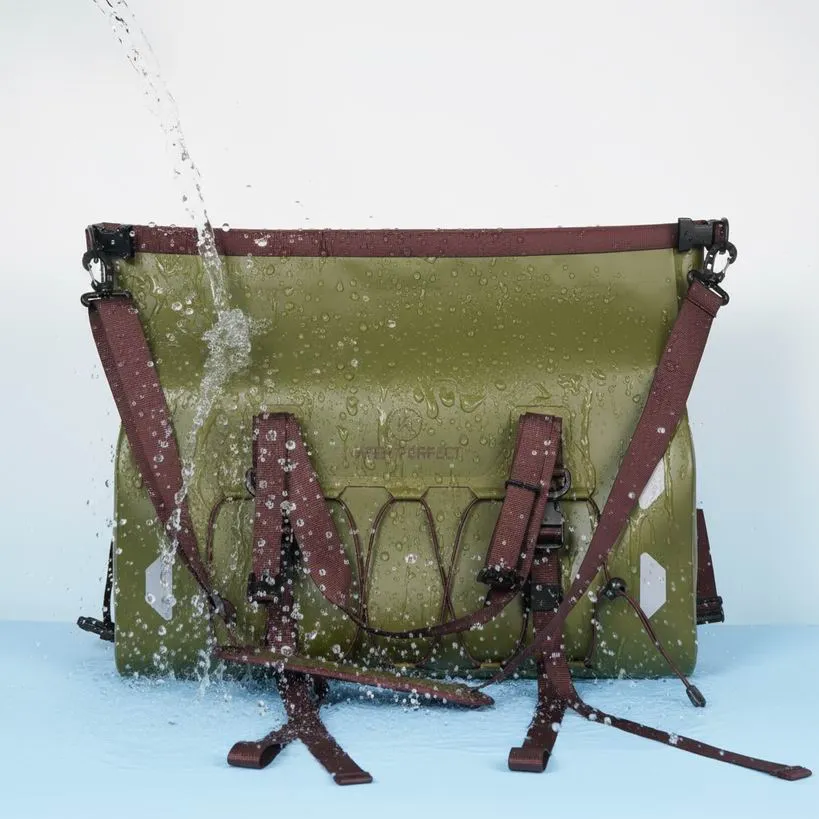
High-frequency welding parameters and seam strength
Dry bags are sealed by high-frequency (HF) welding, not sewing. The fabric is sandwiched between a copper electrode at 27.12 MHz, heated to 160-200 degrees Celsius and pressed at 2-4 bar for 2-5 seconds depending on thickness. The two layers melt and fuse into a single waterproof bond.
A properly welded seam achieves peel strength of 25-40 N per 25 mm width. Below 18 N/25 mm the seam will delaminate after a season of folding. Above 40 N/25 mm the material itself starts to degrade at the weld line.
Ask the factory for the weld parameter sheet (temperature, pressure, dwell time) and a peel test report. Reputable weld operators log these per batch so that a machine drift can be caught before it leaks.
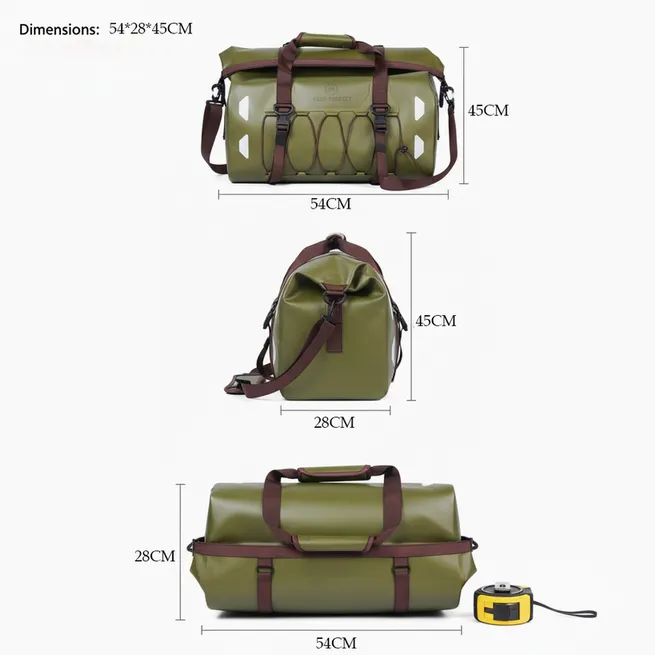
UV ageing and how long a welded bag really lasts
A welded dry bag left in direct sunlight on a deck or rooftop will degrade faster than one stored in a closet. Standard PVC at 0.5 mm typically shows embrittlement and colour fading after 6-12 months of continuous UV exposure. TPU-coated fabrics with UV stabilisers extend this to 18-30 months.
Brands that sell to marine and commercial customers often specify UV-stabilised fabric and add an aluminium coating on the sun-facing panel. If your use case involves long hours on open water, ask for the UV test report (QUV 1000 hours is the common benchmark).
Storage-wise, a dry bag should be dried fully before folding. Trapped moisture inside a rolled bag grows mould on the coating in 2-3 weeks in humid climates, even though the bag itself is waterproof.
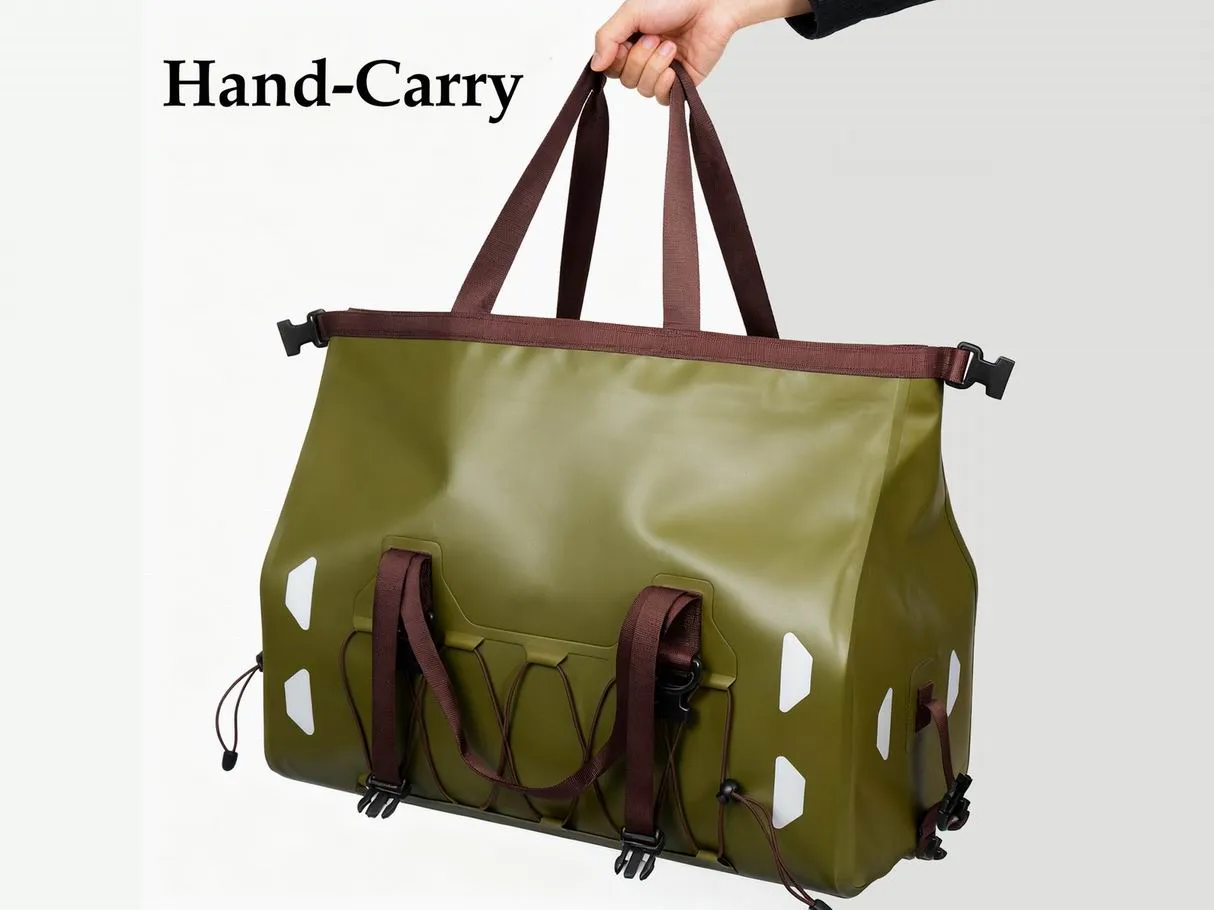
TPU vs PVC: cost, feel and environmental profile
PVC is the traditional dry-bag fabric. It is cheap (roughly USD 1.8-2.6 per linear metre at 0.5 mm), welds forgivingly, and is available in every colour. The downside is plastiser migration over years, a slight plastic smell, and REACH scrutiny on phthalates in the EU.
TPU laminated onto nylon or polyester costs 30-55% more, but it is clearer, softer at cold temperatures, free of phthalates, and increasingly preferred by brands that want to claim a lower environmental impact. It also flexes without cracking below -20 C, which matters for winter expeditions.
For a budget retail brand PVC at 0.5 mm is still the right call. For a premium outdoor brand or one selling into EU retailers, TPU is now the safer specification.
Fabric thickness: what 0.35, 0.5 and 0.7 mm actually mean
Dry bag fabric is sold by thickness in millimetres. The mainstream entry is 0.35 mm laminated PVC or TPU, which weighs roughly 380-450 g/m2 and is the standard for 10L-20L roll-top bags sold at the budget end. It is fully waterproof, but it scuffs and folds more visibly on sharp rocks.
Mid-range bags use 0.5 mm material, weighing 550-650 g/m2. This is the sweet spot for kayaking, boating and everyday outdoor use: it survives abrasion, it welds cleanly, and it still folds small when empty. Most brand-name dry bags at USD 25-45 retail sit at this thickness.
Heavy expedition and boat-crew bags use 0.7-1.0 mm material, weighing 800-1,200 g/m2. These are stiff, almost shell-like, and are built to sit on a commercial deck for years. The trade-off is weight: a 30L bag at 0.7 mm can weigh 900 g empty, which matters for backpacking.
Seam tape, double welds and why corner construction matters
Budget dry bags use a single 20-25 mm weld across the panel joint. Better bags use a double weld (two parallel lines 8 mm apart) which creates a pressure chamber so a pinhole in one line does not leak. Expedition bags add a hot-air taped seam on the inside.
The highest-stress point is the bottom corner, where the floor panel meets the side panel. Weak corners fail first under submersion. Look for a gusseted or boxed corner rather than a square corner, and confirm the weld runs continuously around the curve rather than stopping at the edge.
If you are auditing a factory, run a finger along every corner seam. Rough, uneven weld lines indicate an operator rushing the cycle; clean, flat lines indicate a calibrated machine.
Nylon and polyester base fabrics: what they add
Premium dry bags laminate TPU onto a nylon or polyester woven base fabric rather than using solid PVC. The woven base gives the bag tear strength: a puncture in a laminated bag stops at the weave line, while a PVC-only puncture spreads like a run in tights.
210D nylon is the lightest base, used in ultralight dry bags that weigh 200-300 g for 20L. 420D nylon is the mid-range balance of weight and durability. 840D polyester is used in heavy marine bags where abrasion resistance matters more than grams.
When a spec sheet says TPU 500D, that number refers to the denier of the base fabric, not the TPU thickness. Ask for both the base fabric denier and the laminate thickness in mm.
Zippered dry bags vs roll-top: when each wins
A roll-top closure is the gold standard for true waterproofing: fold three times, clip, done. No zipper teeth to leak, no slider to fail. It is the right choice for kayaking, rafting, boating and any scenario where the bag goes underwater.
A zippered dry bag (typically with an Aquaseal or TIZIP-style waterproof zipper) trades some absolute waterproofing for convenience. You can grab a phone in two seconds without unfolding the roll-top. These bags are rated IPX6-IPX7, not full submersion.
For commuters, anglers and day-hikers who rarely submerge the bag, a waterproof zipper is often the better daily-use compromise. For expeditions and open-boat use, stick with roll-top.
Hardware: clips, D-rings and webbing
The plastic clip on a roll-top bag is usually polyacetal (POM) in black or colour-matched. Cheap clips use recycled POM and become brittle below freezing. Spec virgin POM for any bag sold into winter use.
D-rings are either welded (melted into the seam) or stitched. Welded D-rings are cleaner and stronger; stitched D-rings are cheaper but the stitch holes are a leak point. On a true waterproof bag, the D-ring should always be welded, not stitched.
Webbing straps come in 20 mm (light), 25 mm (standard) and 38 mm (load). Most shoulder straps use 25 mm with a 38 mm load segment at the bottom. Cheap bags use 20 mm throughout, which digs into the shoulder when the bag is full. For in-house manufacturing capacity, tooling and export documentation, see our affiliated manufacturer.
People also ask
How are dry bags made?
The body is cut from waterproof film or coated fabric, seams are welded or taped, hardware is attached, and each bag is leak-tested before shipping.
Are dry bags safe for electronics?
Yes for water protection, but they do not protect against impact. Use a padded or dedicated electronics dry bag and test it first.
What is the difference between waterproof and water resistant?
Waterproof means it keeps water out under submersion or jets; water resistant means it resists light rain and splashes but will leak under pressure or immersion.
What is the difference between TPU and PVC dry bags?
TPU is lighter, softer and more UV-stable; PVC is heavier, more puncture-resistant and cheaper. TPU suits premium packable bags; PVC suits rugged, high-volume bags.
Can you put a phone in a dry bag?
Yes, using a dedicated phone dry bag or a padded roll-top bag. Test the bag first and add padding for impact protection.
What does IPX8 mean on a dry bag?
IPX8 means the bag survives continuous immersion beyond 1 meter under manufacturer-specified conditions. The depth and duration are only meaningful if stated.
What are the different types of dry bags?
Roll-top, zipper, backpack, tote, phone, floating, waist pack, duffel and pouch styles, each built for a different activity and access need.
What is a D-ring on a dry bag?
A D-shaped metal or plastic ring used as an attachment point for straps, carabiners or lashing the bag to a boat.
Key takeaways
- Choose dry bag leak test by fixing the activity, size, material and closure before comparing options.
- Verify waterproofing with a stated IPX rating and a real test method, not a label.
- For bulk orders, confirm MOQ, lead time and a pre-production sample before committing.
- Match material to conditions: TPU for cold and UV, PVC for abrasion, coated nylon for weight.
- A physical pre-production sample is the only reliable way to lock material, color and printing.
- Store dry bags loose and shaded, and re-test the seal before trusting them with electronics.
Related guides
- What is a dry bag?
- Dry bag materials: TPU vs PVC vs nylon
- IPX / IP68 waterproof ratings
- Types of dry bags
- OEM dry bags
Step by step
- Find the stated IPX or IP rating and the test conditions.
- Confirm the depth and duration for any IPX8 claim.
- Look for a dated test report that matches the product.
- Run your own leak test before trusting expensive gear.
Specification checklist
- Fix the specification first - material, size, closure, printing and packaging - so quotes are comparable.
- Verify waterproofing with a stated IPX rating and a real test method, and confirm the batch sampling plan.
- Order a pre-production sample and approve it before bulk production begins.
- Confirm MOQ, lead time, payment terms and the correct HS code before you commit.
- Match the material to the conditions: TPU for cold and UV, PVC for abrasion, coated nylon for weight.
- Ask for a dated test report and a pre-shipment inspection (AQL) for waterproofing and seams.
- Keep the most valuable items in an inner pouch as a second layer of protection.
- Rinse, dry and store the bag correctly to extend its lifespan season after season.
Bottom line
The bottom line is to treat an IPX rating as a claim to verify, not a guarantee to trust. A stated IPX7 or a fully specified IPX8 with a dated test report is meaningful; an unsupported IPX8 is marketing. Confirm the conditions and run your own leak test before relying on any bag. For "dry bag leak test", this is the summary that matters most.
Frequently Asked Questions
Q1. How are dry bags made?
The body is cut from waterproof film or coated fabric, seams are welded or taped, hardware is attached, and each bag is leak-tested before shipping.
Q2. Are dry bags safe for electronics?
Yes for water protection, but they do not protect against impact. Use a padded or dedicated electronics dry bag and test it first.
Q3. What is the difference between waterproof and water resistant?
Waterproof means it keeps water out under submersion or jets; water resistant means it resists light rain and splashes but will leak under pressure or immersion.
Q4. What is the difference between TPU and PVC dry bags?
TPU is lighter, softer and more UV-stable; PVC is heavier, more puncture-resistant and cheaper. TPU suits premium packable bags; PVC suits rugged, high-volume bags.
Q5. Can you put a phone in a dry bag?
Yes, using a dedicated phone dry bag or a padded roll-top bag. Test the bag first and add padding for impact protection.
Q6. What does IPX8 mean on a dry bag?
IPX8 means the bag survives continuous immersion beyond 1 meter under manufacturer-specified conditions. The depth and duration are only meaningful if stated.
Q7. What are the different types of dry bags?
Roll-top, zipper, backpack, tote, phone, floating, waist pack, duffel and pouch styles, each built for a different activity and access need.
Q8. What is a D-ring on a dry bag?
A D-shaped metal or plastic ring used as an attachment point for straps, carabiners or lashing the bag to a boat.
Q9. Does dry bag material affect waterproofing?
The material supplies the waterproof barrier, but the closure and seams decide real-world waterproofing. A good film still leaks if seams or closures fail.
Q10. What are the parts of a dry bag?
Body fabric, roll-top or zipper closure, buckle, D-rings or attachment points, straps or handles, and optional purge valve or window.
Q11. What is the difference between a dry bag and a dry sack?
They are the same product. Dry sack is the more common British and outdoor-store term, while dry bag is used more in the US.
Q12. What is a purge valve?
A one-way valve that lets air escape after rolling, compressing the bag for packability.
Q13. What is the difference between a dry bag and a backpack?
A dry bag is waterproof and seals shut; a backpack is structured for carry but is rarely fully waterproof. A dry bag backpack combines both.
Q14. How do dry bags work?
The body is made of waterproof film or coated fabric, and the seams are welded or taped instead of stitched. The roll-top or zipper then seals the opening.
Q15. What is a floating dry bag?
A floating dry bag has buoyant walls or sealed air chambers so it stays on the surface if dropped overboard, keeping gear within reach.
Q16. Which dry bag type is best for kayaking?
A roll-top dry bag or a kayak deck bag is best for kayaking because both seal tightly and can be secured inside or on the hull.
Q17. How do you close a dry bag?
Do not over-pack. Squeeze out excess air, roll the top down three to five times tightly, then clip the two buckle ends together to lock the roll.
Q18. What is the best material for a phone dry bag?
Clear TPU or PVC film is best for phone dry bags because it is transparent, touchscreen-friendly and seals well in a clamp closure.
Q19. What is the difference between IPX7 and IPX8?
IPX7 is a fixed 1-meter, 30-minute test. IPX8 is a higher immersion level defined by the manufacturer, so it can be deeper or longer.
Q20. When should I use a dry bag?
Use one for any activity near water or in heavy rain - kayaking, boating, camping, fishing, SUP, travel and commuting.